Introduction
I advise reading the tabs in order of left -> right
enjoy your stay!


click for storyline info:
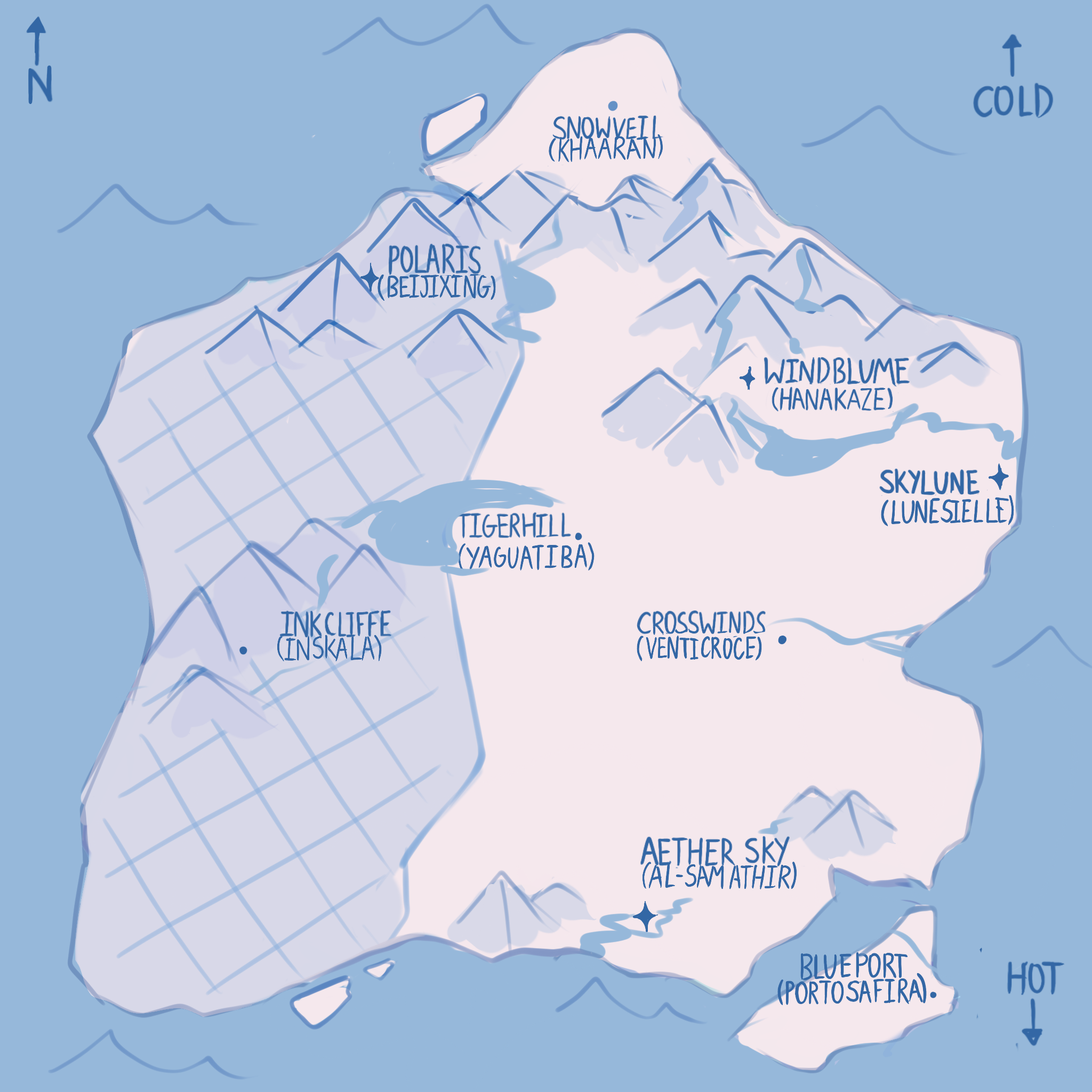
Towards Blue Twilight World's End DeclarationThe setting is a supercontinent of indistinct name composed of countless smaller regions. With each region being so different from the next, its inhabitants found no reason to give the larger landmass a name to unite them. In the wake of the dragon’s rampage, and the destruction of the perceived stability of the modern era, many people have become nomadic, either fleeing conflict in the West, in search of work and stability, or exploring the potential this new, unpredictable world has to offer to a traveller.
Hatched areas indicate regions that fell into conflict after the disaster, usually due to a lack of law enforcement or historical conflict. Harmony does not operate in these regions, CIVIL-REGEN does. The Exorcists' Association continues to operate across all regions.
Bracketed names denote the region's historical name, now only used by the exorcist clans living there. They often reject the modern/standardised dialect.
click the stars to read more: [zoom in and click on mobile]
Terminology
Spirits
A collection of souls contained within a living vessel
A spirit is defined as a collection of souls contained within a vessel that traps them in the living world. The shape of this theoretical container determines the spirit that is formed. These souls are tied to the living world by a tether, a source of strength for that particular spirit. A spirit dies when these souls are scattered and no longer bound to the vessel. They return to the other side.
Spirits are immortal, in that they live forever unless suffering another affliction. Spirits with 'true immortality' will not die in a situation in which they should have been killed — the spirit will return even if its body has been completely destroyed.
Spirits are formed by the clustering of souls in the living world. The environment has a strong effect on their appearance and ideology, leading them to appear in animal-like form. Spirits can be classed into two main tiers - low-level, meaning they possess a less than human intellectual capacity, and high-level which denotes those with a capacity equivalent or greater to that of a human. Only high-level spirits possess the ability to take on a semi-human form. Certain spirits are simply born high-level, while others cultivate intellect over centuries as they gather souls and memories.
High-level spirits can, and do fall in love with humans, but it's become rarer in the modern era. They are only able to reproduce with those with a single core soul - humans, fox spirits, and cat spirits. High-level spirits are capable of romantic and platonic relationships.
Spirits rarely like to move from the region they were born in. More powerful spirits are able to create regions called spirit domains, in which reality is warped by a spirit's memories, thoughts, and feelings. They are where a spirit expresses its truest self, far more than the vessel allows. These domains are linked to a physical location and can only be accessed by a boundary, such as a cave entrance, a gate, or a gap between trees. The rules of time and space do not apply to these areas, and the border between life and death becomes painfully thin. Spirits are at their most powerful within their domains as they draw power more easily from the other side.
The more souls a spirit obtains, the more powerful it becomes. They obtain souls by killing humans and animals of the same species, being near them in their dying moments, or demanding sacrifices. Spirits may also obtain souls by assisting humans and becoming the deity they worship. That way, they will gain another soul whenever any human loyal to them dies. This system led to the creation of exorcist clans.
People have tried to classify spirits into strict types, such as 'luck', 'wind', or 'water' spirits, but there is no easy method of classifying them at higher levels. A spirit’s abilities mature and grow with them, and are often shaped by their personalities and life experiences. They may learn abilities from other spirits if they can understand and link the magic to themselves.
If a spirit falls unconscious due to depression, severe injury, or boredom, it will become dormant. It may inhabit an object or resemble a statue or charm. They can be awoken by exorcists or other disturbances. The spirit will die instantly if this object is destroyed, making it a vulnerable state to be in.
Dragons
Divine spirits, a gift from the stars. Both humans and spirits submit to them
Dragons are spirits born of the stars. They appear as shooting stars and fall to earth, but the stardust never fully leaves them, granting them ‘blessings’ of unrivalled power. It’s believed that these abilities should be used to assist both humans and spirits, ensuring the highest quality of life for all and acting as ambassadors for the supernatural.
They possess strong links to the stars above, while still often possessing another tether, making them incredibly difficult to kill. Until 500 years ago, it was believed that they possessed true immortality.
They may be only dog-sized when born, but they grow to an immense scale. In human form they’re all described to be tall and stunningly beautiful.
Human-changed spirits:
Through certain circumstances, humanity may be exchanged for eternity
Fox and cat spirits are often human in origin. A strong rivalry exists between the two, with foxes considering themselves divine messengers, and cats viewed as self-serving parasites. Both are rare in the modern era, having been classed as neither human nor spirit, and loathed by both sides.
Fox spirits:
The majority are humans who devoted their lives to serving powerful spirits, and had their souls blessed to allow them to live forever. The purpose was to allow them to work important jobs at shrines, or as messengers for deity spirits. Some are 'pure', the children of two fox spirits.
Many aspire to reach the divine nine tails, upon which a single wish will be granted by the stars. The watchful eye of a deity spirit ensures that they keep to a moral method of obtaining souls to gain power, but if something happens to the spirit that guides them, they tend to stray off path and become cunning tricksters who aim to kill or trick humans out of their souls.
Unlike spirits, they are killed just as easily as a human. Their composition is fragile because they can never be strongly tethered to a natural element. Fox spirits often hold some kind of power over life and death because they lie on the boundary between them, making their abilities highly sought-after. These abilities often lure in humans to trick for more souls.
They possess the ability to mimic the voices and appearances of humans they've encountered and some are known to prey on humans or eat their corpses. Perhaps the allure of their lost humanity is too great…
Cat spirits
Humans transformed into spirits by hatred and misfortune. Unlike fox spirits, they didn't receive the blessing of immortality from a spirit and are instead tethered by the resentment that haunted their dying moments.
They tend to have lived miserable lives. Shunned, unwanted and unlucky, they die and are reborn to terrorise the living who caused them to end up that way. Spirits can prevent this transformation by providing troubled humans with good luck charms, charms to ward away evil, or charms for mental peace.
Cat spirits are fragile like fox spirits, but possess nine soul tethers, or 'lives'. Most exorcist clans burn them at the stake to dispose of them most easily.
They have some level of control over ghosts, and may puppeteer them as they see fit, acting as an anchor point for these loose souls.
Ghosts
Humans who couldn't pass on after death, trapped souls.
Humans with lingering resentments or regrets may be unable to cross over, tethered by these negative feelings. They lack a stable vessel and have a weak tether, leading their minds and bodies to rapidly deteriorate unless they kill humans, spirits, or animals and consume their life energy. The longer the lifespan of the being, the greater the positive effect.
The possession of a tethered soul without a body distorts their appearances - they gain horns, claws, tails, and occasionally wings, much like spirits, as they try to anchor themselves to the living world, leading them to become known by many names in regional folklore - vampires, for example. The more distorted the form, the less capacity for thought the ghost retains.
Ghosts who have their humanity 'sealed' will remain human-like for longer and can be sustained with blood.
Many have lost themselves long ago, mumbling phrases they knew in life while having lost the capacity for rational thought. They attack without thinking, spurred on by the desire to live, but memories of life influence the way they fight.
They bring misfortune, death, and disease to people living in areas they haunt. This makes them the main target for exorcists. However, many exorcists become ghosts after living miserable lives. It's an unfortunate cycle
They’re known to fear and avoid cats.
Exorcists
The descendants of the offspring between humans and spirits, watered down into a human appearance over time. They can see and sense supernaturals, and may possess certain abilities.
Exorcists are born into family clans linked to a deity spirit. Their familial links to the deity or another supernatural (often the fox spirits serving the deity), grant most the ability to see and sense the supernatural. The unnatural traits of the half-spirit children were subdued over countless generations while their abilities persisted and eventually became desirable. This led to corruption within clans such as forced marriage and the culling of children who lacked certain abilities.
Forced marriages are permitted even in the modern era, The Exorcists' Association justify it by claiming that if they didn't force marriages, or exorcists had children with non-exorcists, then the ability to see supernaturals would die out over time, leaving nobody to fight against them
They dress in traditional clothing, rarely attend school or interact with outsiders outside of business purposes, and hold more historical values. Many also speak an older regional dialect. Whether they want this life or not, being born into the exorcist clan system traps them.
A popular style of makeup involves the mimicry of supernatural markings on the face. The reasoning varies by region and clan, whether started out of superstition to scare away the supernatural, an attempt to blend in amongst them, or to honour the appearance of a deity spitit.
Clothing is highly personal to them. Exorcists tend to die relatively young during combat, so they may as well look good. Each clan tends to have juvenile and mature uniform styles that follow certain conventions to ensure a degree of uniformity while allowing for personalisation. The mature style is often divided into masculine and feminine categories that clan members are expected to conform to, but this varies by clan. The clothing style and colour indicates the particular family clan, as well as their wealth relative to nearby clans,
Exorcists are often traumatised by work, or by being raised in an environment full of traumatised individuals. Suicide and severe mental health issues are not uncommon, as well as lifechanging injuries. However, because being viewed as a burden is the most shameful thing of all, most exorcists of low standing within the clan will work until they are killed.
Their family clans often provide other supernatural-related services to the community, like purifying water sources or preventing disaster by mediating with local spirits.
Exorcists train to work in pairs and integrate into larger groups when taking down more powerful supernaturals. They are generally trained to assume a certain 'role' in combat, such as getting up close to the target to draw attention, or sticking close to assist a stronger partner. These roles are often called 'classes' and help to indicate whether exorcists might work well together against a certain supernatural, or if they're better off finding a working partner of a different class.
Some exorcists may be trained in multiple classes. They are generally as follows:
Duelist
Exorcists who possess the courage to get up close and personal with the supernatural, often wielding short-range weapons and relying on the assistance of a fighting partner.
They use lightweight weaponry to allow for quick movements.
Striker
Exorcists who wield heavier, more destructive weapons designed to dispatch threats quickly and decisively.
They lack the agility of duelist-lass exorcists but make up for it in overwhelming strength.
Support
Exorcists tasked with supplementary roles, such as the creation and use of seals and spirit ropes.
They also handle the investigation and location of supernatural threats. It's not uncommon for them to study basic medicine too. They're often within the upper limits for acceptable levels of supernatural blood.
Mediator
Exorcists who form contracts with spirits in order to fight, whether by borrowing their power or having said spirit work alongside them. In certain cases exorcists have been known to allow a spirit to possesss them.
This role often overlaps with another class, and remains incredibly rare.
Mage
This class is no longer recognised due to the higher portion of supernatural blood required to cast spells quickly.
They were exorcists capable of fighting the supernatural on its own terms by drawing on the power of the stars to utilise constellation spells.
Relevant exorcist clans
Not all character examples will match the clan appearance description, that is only a generalisation.
The Reinfuchs clan

Kotone Reinfuchs and Shiro Nehme.
A leading clan in the Inkcliffe region, reknowned for their members' capacity to make powerful seals on paper, via tattoo, or scarification. They follow a fox-spirit deity said to have imparted this wisdom upon them.
Internally the clan is brutally hierarchical. Nobody questions the families in higher standing, and those below are deeply afraid of causing trouble. This culture has been implicated in multiple deaths, both on and off duty, but investigations by the EA rarely get far. The members refuse to say a word against the clan itself.
Notable physical traits include a pallid complexion, dark eyes and fine, light hair. Their clothing is dark in colour, and the juvenile uniform features gold buttons, knee-high boots, gold-rimmed shirt cuffs, and a large shirt collar. The adult uniform maintains similar traits, with 'immature' clothing like over-knee shorts or skirts changed for longer trousers or skirts.
The François-Rossiele clan

Basile François-Rossiele
A ruling clan in the Skylune region due to their dominion over the Exorcists' Association and the region's legal system. While the clan's ability is supposedly to set weapons ablaze in moments of absolute conviction, few in the younger generation have been able to pull it off. It's said this ability was born of their deity spirit, The Justice, Nero. He was appointed by blessed Dragon Shiloh to judge humans and spirits alike, and to weigh the very truth they spoke.
The role of clan leader may be awarded through merit rather than birthright, spurring intense competition amongst the families within it. Appearances are everything - one scandal is all it takes to render years of work fruitless, and the newspaper is far more forgiving of a pretty face.
This clan no longer has any notable physical traits. Their clothing is dark or blue in colour, and features butterfly and rose motifs demonstrated wherever possible. It strays to the more extravagant side of exorcists' clothing, and they would find themselves hard-pressed to have repairs done in any region but Skylune. Their uniforms are more lenient than many clans, to allow their members to peacock in a way, but it's still seen as unbecoming for a mature exorcist to have legs uncovered above the knee.
The Guerreiro clan

Mar Guerreiro
A low-ranking clan concentrated around the Blueport region. Their members are associated with strength and courage, qualities historically attributed to the swordfish deity they follow.
Most of their work lies in accompanying fishing vessels, leading members to develop a unique talent in fighting aboard small boats.
Distinct traits include a tanned complexion, dark eyes,and wavy or curly blue hair with orange strands snaking through. Their manner of dress is much like the sailors of the past, and they follow a similar custom of more mature exorcists covering their legs above the knee.
The Long clan

Daiyu Long
The ruling clan of the Polaris region, with an unusual custom in which their deity spirit, Chouyan, is no more important than the current clan leader. Their views on gender are also somewhat more lax than other clans, seeing as their first ruler was an empress.
The clan was scattered in the wake of the Beijixing 100-years war, and their role and ranking varies by region. There are many smaller families scattered in the hils and mountains surrounding the city, none of whom are considered particularly important, while the ruling family were celebrities of the modern era.
Notable traits include a tanned complexion and dark hair with a reddish colour or gradient, styled to feature at least one braid. Their manner of dress is incongruous with the snowy region they inhabit due to a curse that causes them to overheat. Children wear loose, flowing garments to cool off, while those considered adults may choose to show more skin than one usually would in such a region, wearing cropped shirts, over-knee skirts or shorts, and many more varieties of clothing.
The Hye-Rin clan

The carp deity Hye-Rin and Seung Hye-Rin
The lowest-ranking clan in Polaris who carry themselves with pride despite everything. They follow the carp deity Hye-Rin with fervour, going so far as to blind themselves in one eye to display their absolute devotion; the remaining eye is for Hye-Rin, and Hye-Rin alone.
The members of this clan were so loathed in the wake of the 100-years war that exorcists from other clans refused to marry into theirs, leading the Hye-Rin clan to quickly die out since the ruling Long clan refused to register non-exorcists as valid spouses. In the modern era there is only one surviving member.
Notable physical traits include a light tan complexion, dark hair, and multicoloured eyes much like the spots of the koi.
The Belghina clan

Vance Mikhailov
A clan without ranking, scattered throughout Snowveil but concentrated around the 'bootcamp' region. They're said to have subdued the canine spirit of many bodies and many names, commonly known as 'Lupi'. Having taken some of its bodies and domesticated them into becoming mere dogs, they developed the 'Northern Spirithound' breed, admired for its tenacity, strength, loyalty, and endurance.
Many members of this clan do not officially qualify as exorcists as a result of their high supernatural blood component, but finding exorcists in Snowveil that fall within the Association's range of tolerance is nigh-impossible, so they continue to find work in spite of the fact. Much of their work lies in accompanying hunters and transporting supplies across the unforgiving terrain using teams of sled dogs.
Notable traits include a light complexion, even lighter hair, and piercing yellow-grey eyes much like the dogs they command. Their manner of dress follows fewer of the other conventions that many clans fret over.
The Biković clan

Yasmin, of unknown surname
A low-ranking farming clan in Polaris who follow the bull deity Tur, and have sworn to kill her counterpart, Korida. They're now admired for their peace-loving ways and the overwhelming physical strength their members seem to possess.
They're scattered around the steppe to the east of Polaris and view tending to the bloodsoaked land their burden for the terrible role they played in the 100-years war. They developed heavy artillery and used their livestock to transport it, drastically increasing the death toll of the conflict.
Unwilling to shed the blood of living creatures anymore, they eat an exclusively vegetarian diet and focus on killing the supernatural alone. Distinct physical traits include a light-tan complexion, dark hair, and vivid green eyes.
Half-spirits, part-spirits, and chimera
Neither exorcist nor spirit, these supernaturals lie in a grey area in which they struggle to fit into the strict categories defined by the modern era.
A half-spirit is the direct offspring of a human and a spirit. The term 'part-spirit' refers to partially supernatural beings with 20-50% supernatural blood, while the general term supernatural is used to describe anything above 50% and less than a pure spirit, often the offspring of a half-spirit and a spirit. Though the term supernatural is used to describe any non-human.
All half and part-spirits are considered chimera, the fusion of human and inhuman (supernatural) traits. The term chimera is most commonly used to describe those with an undesirable appearance; inhuman heads, completely animal-esque limbs, or non-human torsos. These chimera have always been shunned by humans and exist in mythology as mermaids, minotaurs, harpies, and other creatures.
Chimera typically display many of the traits associated with a spirit’s humanoid form, but lack the flexibility of true spirits. They are unable to alter their appearance any more than a human, or maintain illusions without finding a way to access magic.
Furthermore, because many spirits lack defined gender or sex characteristics, the chimera tend to fall into human ‘intersex’ categories. Their bodies may change unpredictably over time, and their identity may not align with physical form, which often leads to a wider sense of dysphoria exacerbated by the appearance of non-human traits later in life such as fur, feathers, claws, or scales.
Historically chimera have always lived amongst humans where possible, often maintaining a drive for social connection inherited from their human side even if their spirit nature inclines them to solitude. They are often described in contradictory terms — dangerously emotional or inhumanly cold, frighteningly powerful or pathetically weak. Each is different, and so categorisation will always fail.

Jiao, the dragon chimera.
The paper wish curse
"Have you heard the rumour? If you wish on a paper crane it'll come true, but only if you're a good person."
A curse that befalls those who wish upon a paper crane. The magnitude of the wish that can be granted is proportional to the person's capacity for destruction, should they succumb to the curse.
It's said that good people will not be affected, yet it seems that nobody can meet the threshold, or knows what defines one in this case. Even the most kind-hearted are driven to madness.
Humans tend to kill themselves or be killed, and become cursed ghosts or cat spirits.
The source of this power is not fully known or understood.
Notable organisations
Harmony
The Harmony Exorcism Company
Founded in 19XX by Xion Nehme, the company offers an alternative pathway to work outside of the standards set by the Exorcists' Association.
The company is willing to licence supernaturals, unlike the Exorcists' Association, and lacking a family clan is a non-issue to the company. As long as a blood test proves that you can perceive the supernatural then a license is almost guaranteed.
The largest training centre is located on an island in the city of Aether Sky, however smaller regional centres are scattered throughout the western continent. Exorcists are stationed according to demand, though the may request transfers or temporary assignments elsewhere.
The company markets its twelve strongest exorcists, the generals, much like pop idols. They take interviews, feature in games shows, and pose for fan-magazines. By becoming more culturally relevant and marketable to the wider population, they have eroded some of the stigma surrounding exorcists and thrust themselves into the limelight.
It helps that the company's owner is an exceptionally charming man, almost inhumanly so. He claims to have been given authority from the blessed dragon of dreams to set up the company, and alleges that it more closely aligns with blessed dragon Shiloh's principles than the EA.
All profits leftover from its own maintenance go to charities, mostly those assisting with reconstruction in the wake of the Dragon's Rampage.
Their current focus is the 'paper wish curse' sweeping the continent in the wake of the rampage.
The Exorcists' Association
In the name of Blessed Dragon Shiloh...
It's unclear exactly when the Exorcists' Association was founded. It's believed to have formed gradually as a result of The Justice and The Executive passing laws to permit the rapid elimination of dangerous supernaturals, decriminalising the act of killing a spirit before bringing it to court.
The association sets the laws for exorcists, as they're generally granted immunity from criminal law while carrying out their duties, hence the importance of the license. An exorcism may be indistinguishable from murder to an outsider, and an exorcist may be legally permitted to kill another human in certain cases. The Association determines whether the act was a legitimate exorcism or criminal offence.
They have access to all data regarding family bloodlines and their abilities, and believe in pure family lines where exorcists only marry into other clans and not ‘outsiders’ or , worse, supernaturals.
The EA enforces that those with 30% supernatural blood or more are not exorcists, but supernaturals, and therefore cannot be licensed to work as exorcists. Those with 40% or more are not permitted to marry into exorcist clans in order to maintain control over the strength of their abilities and to avoid conflicts of interest regarding identity when exorcising spirits. These genetics can be analysed via a simple blood test.
Exorcists must come from registered bloodlines, without exception. Transformation into a supernatural voids one's license, and the person should be registered as dead.
The Association's headquarters is located in Skylune, and headed by the François-Rossiele clan leader.
CIVIL-REGEN
The Eastern Continent under martial law
CIVIL-REGEN was founded in the wake of the Dragon's Rampage, its members composed of emergency workers, doctors, law enforcement, and the now-disbanded regional militaries. Its purpose was simply to save people in the wake of the disaster, aid in surviving the poor conditions, and to rebuild in the aftermath.
Due to historical conflicts that spread across the West following the deaths of blessed dragons Shiloh and Shulong, many regions were politically tense even in the modern era. The Dragon's Rampage pushed many into outright anarchy due to infighting amongst exorcist clans. This was partially resolved by CIVIL-REGEN's intervention.
Many of the divisions started independently before establishing communication with each other over radio. Over the years they developed uniforms, built supply links, and became the more organised front seen today.
It is unable to function as a nonprofit and relies on more than donations. The company works on developing medication and putting out medical research to sell in larger cities in the Eastern Continent. They also take brand deals and sell certain products to the inhabitants in the cities they control, from essentials like powdered milk to luxuries like vehicles and jewelry. After all, they hold a monopoly on what gets imported or exported.
CIVIL-REGEN tends to recruit people who live in the region of the particular division's operations. They outsource certain jobs like mail delivery and shop management to individuals who can apply for contracts with the company.
They have a head office in Aether Sky, more to handle legal issues and queries than to do anything there.
The company has faced countless allegations and scandals regarding the treatment of the people they claim to be protecting; from assassinations and human experimentation to exploitation and blackmail. However there's no alternative, and simply disbanding the company could get people who rely on them killed. They're a net positive at the end of the day.
History / Timeline
The Twilight Era - 20XX+
The modern era was defined by the rejection of the supernatural, the acceptance of science as the hard truth of the world, and peace at last. With the introduction of centralised power systems like governments and councils, fractured regions that were once ruled by exorcist clans and their deities were unified by authority.
The most powerful spirits had long since destroyed one another in war, and those that remained lacked either the strength or the will to shape the world as they once had. The supernatural fell quiet in the newfound peace. The reduced death rate in humans and lack of major tragedy limited the formation of spirits, and those that existed were nothing like their mythic predecessors. Those that belonged to neither side were driven out, and in time, disappeared.
The stars lost their significance as mystical sources of power as space programs reduced them to distant, burning spheres of meaningless pattern, and city lights slowly erased them from sight.
Some suspect the dragon's rampage to be judgement cast upon humanity, a firm rejection of modernity and progress, revenge for what was done to the others, or simply an errant fault line given too much meaning. Whatever the reason, much of the modern era’s progress was undone in a matter of days, ushering in a new age —the reawakening of the supernatural amidst the ruins of the modern era.
It was aptly named the ‘Twilight Era’, reflecting uncertainty over whether humanity was approaching its dusk or its dawn; a slow ending, or the beginning of a new world.
3000+ years ago - Dawn
The first records bearing similarity to the modern common dialect are written. Many towns towards the southwest describe a massacre occurring the same night as a meteor shower in a Southeastern region known as Lumos. Many feature sketches of two young dragons labelled the blessed dragons of dreams and peace. Their appearances only cause turmoil as the killers of Lumos’ people pursue the dragons and destroy the villages in their wake. Records of their appearances in this region end abruptly.
The blessed dragons to the Northeast, North, Mid-east and Southeast are known as the blessed dragons of wisdom, eternity, passage, and memory respectively. Dragons are understood to be immortal spirits.
In the Northwest, Beijixing is established with its first formal emperor. It is established that there will be six emperors before blessed dragon Shulong will assume the throne for all eternity, giving them ample time to learn all that they must.
2000+ years ago - Sunrise
Beijixing, now known as Polaris, develops one of the first formal examination systems in order to determine the allocation of roles within the palace. Those who pass and serve well in their posts are blessed to become fox spirits. The children of said fox spirits find favour with the dragon, and are better-suited to pass the exam with their parents' tutoring. This is the beginning of the Long clan who will serve their dragon for over a thousand years.
Lunessiele — modern day Skylune — has its monarchy overthrown in favour of blessed dragon Shiloh’s leadership. The region becomes turbulent as the existing military fractures between those willing to follow Shiloh, and those hoping to fight the coup. A brief civil war ensues, and the power held by noble families becomes uncertain. Shiloh begins appointing council members, blessing their souls to become fox spirits. The legal framework which evolved into that of the modern era is developed in ancient Skylune.
In Aether Sky, then known as Al-Samathir, the royal family welcome blessed dragon Xion in as one of their own, and surrender leadership to him. The heir, Shahin, is assigned to be his personal guard. Xion gathers a small council of six ministers to lead with him, and eventually resigns himself to symbolic duties only. Many old systems are overturned in the hopes of creating a utopia using the dragon’s blessing.
1000+ years ago - Zenith:
Aether Sky reaches a breaking point following infighting and controversial actions taken by the ministry during their descent into madness. Afflicted by the paper wish curse, each minister pushes themselves to the breaking point in a bid to create the paradise they were entrusted to build. Their influence expands much faster than the administration can manage, and Xion is too distrustful of others to delegate. Instead he reassures them that they're doing well and that things will work out in due time.
Xion’s authority erodes as he is increasingly portrayed as lazy, ignorant, and hedonistic — a dragon content to doze in luxurious pools while the region suffers. His striking appearance becomes a topic of ridicule as increasingly vulgar claims are spread about his relationships with the leading ministers.
Blame for the poor financial situation of the region is spread evenly amongst the five ministers; War, Trade, Faith, Agriculture, and Education, and increasingly falls on Xion himself. Those in towns on the outskirts of the empire rarely see the wealth they were promised after the conquest that absorbed their territories into it. A promise from a spirit is a contract, and not one to be broken lightly.
These discussions spark outrage, and an army is gathered to take what they believe to be owed. The royal guard clashes with them in the streets of the capital. Amidst the chaos, late into the night, a lone star is swallowed by the northern skies, and many claim the dragon fled.
Fearing for Xion's safety, the minister of Faith, Anouar, uses an illusion to take the dragon's form and lure the revolutionaries deeper into the city. Once he is cornered within Xion's shrine, he activates a series of constellation spells drawn encircling the city. Aether Sky and all its people are annihilated.
Blessed dragon Xion flees north to Lunessiele to reunite in secrecy with his sister, Shiloh. He remains there while the conflict in the south subsides, terrified he will be blamed for Aether Sky's erasure.
To the Northeast of Skylune, a brutal plague strikes the region known as Hanakaze, now Windblume. Many believe it to be punishment for a young dragon spirit driven into the forest by a group of children. Driven to desperation, many leave toys and snacks out in hopes of gaining the dragon’s favour; feathers that ward away disease, and the healing mist that drifts down the mountainside at night.
A traveller known as Xion appears in the region shortly after the plague subsides, and coaxes the young dragon out over a period of many weeks. She is established as the blessed dragon of healing, Tatsuko.
Approximately two hundred years later, the region suffers devastating wildfires following an unusually parched summer. Many villages are razed to the ground, humans and livestock succumb to smoke inhalation, and the surrounding wilderness is ravaged. There is no hope for the following harvest, and many fear the coming famine.
A lone shooting star bestows the blessed dragon of creation upon Hanakaze. The following blessed rain nurses even the most blackened scraps of vegetation back to life in a matter of days. However, the rain does not stop and the people face yet another tragedy in the form of a flood that claims many lives that the wildfire spared.
Blessed dragons Xion and Tatsuko withdraw and travel the mountains in search of the cause. A weeping dragon is discovered lying in a low-altitude waterfall, and given the name Ryuko.
500+ years ago – Sunset:
Tensions rise as Windblume becomes a point of interest to its neighbouring region, Aidala, now known as Moonsteppe. Windblume remains the only region inhabited by multiple blessed dragons, drawing hostility from the dragonless region. Unable to defend itself from potential attack, King Yoshihito and Xion enter negotiations with the region’s officials. It’s proposed that Ryuko and Xion leave with them, and links/trade between the two regions will be increased. Xion agrees in the hopes of preventing any violence.
Negotiations fall through once they ask that Ryuko be betrothed to a member of the ruling family there. Moonesteppe hopes to place Ryuko as a ruling figure rather than a decorative ornament. A way to tie the dragon to Moonsteppe, grant him ruling power of his own, and strengthen the legitimacy of its ruling family. Xion absolutely refuses to negotiate further and the king sides with him. Even if they give in to Moonesteppe’s demands, it won’t guarantee that they won’t demand more if they have such audacity.
However the Lantern Festival, the only event in which the young dragons will descend the mountain, is still scheduled to go ahead. The attendance of blessed dragon Shiloh and her knights from Lunesielle is to serve as a thinly-veiled warning to potential attackers.
The festival is packed with more attendees than the main city can even hold, and the celebrations of that fateful night spill out into surrounding villages.
As feared, a full-scale attack is launched with intent to abduct one of the dragons. During the ensuing conflict, blessed dragon Shiloh is killed.. Accounts of the event are contradictory; some claim to have seen a narwhal spirit, others a fox spirit, and some even attribute it to the actions of a human wielding a dangerous artefact.
Shiloh’s death triggers widespread unrest as the fact that dragons can be killed is brought to light. Revolutions erupt across multiple regions as ruling spirits are overthrown or disappear.The divide between humans and spirits deepens irreparably as each side blames the other for issues within their regions. Fox spirits become universal targets and are driven into isolation across many lands.
Most notably, blessed dragon Shulong is killed by the Long clan, and their body distributed to the people of Beijixing to get them through an exceptionally harsh winter and famine, after countless pleas for the dragon to intervene fall on deaf ears. Their actions trigger the Beijixing 100-years war.
The Hundred Years War was an extended conflict between four major exorcist clans and their deities; The Long clan and false dragon Chouyan, the Bikovic clan and nurturing spirit Tur, The Hye-Rin clan and the ink-sea spirit Hye-Rin, and the Dawa clan and the ghost of the mountain Dawa-Dorje.
The Hye-Rin clan did not want a human ruler as the Long clan proposed, and declared war even after the Long clan presented them with false dragon Chouyan. They rallied the external territories of the empire, including the Bikovic clan, and fought extenstively in a bid to take back Polaris. They were ultimately unsuccessful.
The relentless brutality of this conflict led to the general separation of exorcists from broader society in many regions, as Beijixing's new government relegated them to a separate 'Exorcists' District' and many regions followed suit.
In Hanakaze, the response is much quieter. The people of the region urgently search the hills, mountains, forests, and valleys in search of the missing dragons Ryuko and Tatsuko, believed to have fled in their terror. Debris is pulled aside, mountain paths scoured, yet nothing is found.
Years pass, and life has no choice but to resume. Eventually, only Xion continues the search, calling their names every day come rain or shine, until his voice runs raw.
Xion becomes a figure of legend to later generations who hear the story of the Lantern Festival and offer him shelter when he passes through nearby villages. He’s said to recount the story with details as vivid as if it occurred yesterday, gaze soft and distant as he describes the two children, always the same way; "gentle hearted, only this tall”. At last, Xion leaves Windblume, and the tale fades with his presence.
The following Lantern Festivals are mournful, but soon pick up vigour. The children wouldn’t want to come back to a funeral, people say. They’d want to see lights, colour, celebration. Something bright enough to call them home. The festival returns to its joyful origin; a celebration of all that the previous year brought them, and a hope for the following year; perhaps even the return of the dragons.
20+ years ago – Nightfall:
The modern era, and the disappearance of the supernatural from everyday life. Concepts like magic, destiny, and the soul are widely rejected. Humans are, for the first time, widely governed by humans.
That is, at least, how it looks on the surface.
Those who hold real power know better. They understand and utilise the supernatural, forming contracts, gathering lucky artefacts, and fighting to shape their destinies into ideal outcomes. They may even be spirits themselves taking on human disguises. The supernatural is more hidden than it is dead, heavily pressured by the newfound lack of relationship between supernaturals and exorcists.
The world simply has no place for spirits, and they respond by falling dormant, retreating into the last wildernesses, or imitating humans. Some fox spirits go as far as to give up their immortality to live one last human life.
The Twilight Era - in continuation:
In order to prevent societal collapse after the initial earthquakes destroyed major cities, alongside the central governments and military, exorcist clans who had historically ruled the regions as royal families seized power.They possessed their own internal hierarchies, understood the supernatural repercussions of such widespread disaster, and the skills to deal with them.
In regions where clan hierarchy had been disputed, or wars had historically broken out amongst the clans, this takeover was often slowed by exorcist infighting, leading to the absolute collapse of law enforcement and the ensuing conflict and violence.
The exorcist clans that seized power ended up becoming faux regional governments/city councils, restricting the number of people free to deal with the supernatural threat posed by reawoken supernaturals and the ghosts formed by those who died. The Harmony company trains and sends exorcists all over the continent to deal with these newfound supernatural threats.
Magic system
Tethers:
A stronger tether means a spirit is more strongly attached to the living world, making their souls more difficult to disperse. As a result, the strongest tethers exist in the world around them; earth, wind, and water, for example.
A weaker tether means a spirit’s souls are less firmly bound to the living world. The spirit is fragile and easily killed. A celestial tether is the weakest of all, but grants spirits possessing one unrivalled magical capacity.
Spirits that draw their power from the stars are able to achieve dominion over abstract concepts like time, death, and hope, as well as utilising devastating attacks that sever souls from the living world. This is because their true source of power is the reservoir of souls on the other side, which mirrors the arrangement of stars in the sky above.
A spirit’s tether to the living world may also be strengthened through interaction with humans. The act of perception solidifies a spirit’s identity, and therefore its form. The more clearly a spirit is observed, remembered, and understood, the more firmly it is anchored to the living world through the memories of those who witness it. Ghosts prove that souls can be bound by emotion and memory.
Artefacts:
Items of significant sentimental value to a spirit, and of high-value to exorcists wanting to make less-than-ethical money.
The only moral way to obtain an artefact is to receive one as a gift, or to kill a cursed spirit. Saturated with strong emotion and memories from the spirit who created them, they manifest abilities influenced by this imprint such as; breaking seals or curses, healing injuries, bringing fortune, or even granting access to magic and its abilities.
Some exorcists hunt down spirits to obtain and sell or use their artefacts. Even the physical components of a spirit, like fur or teeth, are artefacts and are sometimes used as medicinal or aesthetic products. However, they may contain so much of the essence of the spirit that it’s possible to reconstruct an artificial vessel based on the original.
Magic:
The visible cosmos serve as a reflection of the patterning of souls on the other side. Spirits who understand the parallel may achieve total mastery of their abilities. The sky, the ocean, glass, mirrors, a shimmering dewdrop, all express different facets of the same reflective system. Through this the structure of the stars can be interpreted by each individual, allowing them to channel power from the reservoir of souls on the other side.
Accessing magic:
The methods used to access magic vary by region, but the most well-known method involves drawing individual, basic spells as celestial magic circles and connecting them to form more complex ‘constellation’ spells. Developed in the North, by Shulong, and the South, by Anouar, this method directly draws power from the other side. In humans, an artefact is often required to serve as a conduit, or their life energy or even a soul must be used to complete the ‘circuit’.
In spirits, this is a highly taxing form of magic for those without a tether to the stars, and requires years of study for those who possess one. Draw the wrong constellation, and it’s possible for a spirit’s body to be rendered apart.
However, those with supernatural blood possess a strong emotional imprint that allows them to make ‘pseduo-artefacts’. By handcrafting items such as spirit ropes, seals, and veils, out of materials of supernatural origin, they may imbue them with particular abilities, eg a sword forged in a spirit’s flames may burn with the user’s determination, a veil sewn from thread made of fur may mask the wearer from spirit’s eyes, and carving runes into treasured items may imbue them with a protection spell.
Seals can be used to bind abilities, curses, souls or prevent supernaturals from crossing a boundary. A seal’s strength depends on the magical capacity of its user, and the emotional imprint placed on it. Certain rituals or magic systems may be created to strengthen the imprint. Stronger spirits may overcome seals by sheer power. There are different ways of creating seals - paper tags, scarification, tattooing, and branding to name a few.
Spirit ropes are a restraining tool used to suppress a spirit’s physical strength and energy. They are formed using similar techniques to those seen in seal creation.
A soul is one’s identity, and one’s identity is shaped by emotion and memory. So, emotion has the ability to act as a form of magic ‘currency’.
Curses:
When a spirit’s identity is warped in a destructive manner, it is cursed. A curse serves as a reflection of a spirit’s unstable mental state, whether afflicted by its own strong emotion or that of another, curses are always tied to memories.
A spirit may curse others, or its surroundings, projecting its distorted identity/worldview onto them
The other side:
A dark place illuminated by the cold glow of countless souls. The surface of the abyssal ‘sea’ is still as glass, mirroring an infinite stretch of ink-black sky. Above and below, souls drift in vast numbers, yet their presence does little to dispel the darkness. Their patterning is said to mirror that of the stars in the sky.
It is possible for spirits to be born in this region due to the accumulation of souls that occurs. Unlike spirits in the living world, they require no tether as they inhabit the very location that souls naturally drift towards. Some form contracts with newly-arrived souls they find interesting. Without a tether, it is impossible for them to cross into the living world, so they form contracts and bless souls to become fox spirits for one singular reason; the conservation of the strength of magic.
In order to maintain the strength of magic in the living world, there must be a proportionally deep reservoir of souls. Too many living, and not enough dead, and there is limited power to be shared. In the past, the great empires brought about by dragon spirits led to many lives, and therefore deaths. Even if the dragon deity absorbed many souls within itself, it prevented the countless deity spirits that exist now from generating influence, gathering, and therefore trapping souls in the living world.
Illusions and appearance:
All spirits may take on a semi-human form based on at least one person, as it’s a transformation that requires a point of reference. This appearance reflects the way they truly see themselves as a human, and so the age of the human form directly correlates to the spirit’s approximate mental age. Certain physical traits, such as height, are influenced by the spirit’s original form and its relative scale within that species. Features like ears, tails, wings, claws, or horns often remain visible unless altered through an illusion. Some spirits maintain more of their original anatomy, such as animal limbs or non-human heads or facial structures. These traits often indicate a spirit is less aligned with the concept of ‘human’.
Many spirits use the first person they encounter as a point of reference, or the first to show them kindness. The reference model does not necessarily need to be human — it can be another spirit’s humanoid form too.
Illusions describe the act of taking on an appearance that is not natural to the supernatural, and does not align with their true self (e.g. suppressing wings, horns, or tails, to appear fully human, appearing like another person entirely, or an animal or object). Few spirits can cast illusions to take the form of other spirits, but find more success and ease in the mimicry of humans. The difficulty in mimicking other supernaturals, like half-spirits or ghosts, lies somewhere in between and is a case-by-case basis. The more similar the target (fox spirit to fox spirit, for example), the easier it may be.
To be convincing, spirits may also actively suppress their presence, the ‘imprint’ of the cluster of souls in the living world. Exorcists are able to detect these presences as part of a sixth sense.
Spirits using illusions can do so to three tiers:
- I. Deceiving regular humans
- II. Deceiving half-spirits, ghosts, and exorcists
- III. Deceiving other spirits
Tier III Illusions are uncommon, requiring far more energy from the spirit. It may also put them at risk of being attacked by supernaturals that would ordinarily steer clear for one reason or another. However, certain spirits, exorcists, and supernaturals have abilities that allow them to ignore even third-tier illusions.
Illusions do not alter the structure of the spirit, they only alter the way it is perceived. As a result, a spirit’s true identity may be revealed through presence, behaviour, or the instability under strain. By failing to express its true self, the spirit is somewhat weakened by the illusion.
Illusions are actively maintained by the spirit and are first to collapse under distress. The humanoid form, shaped by self-perception, becomes unstable in dire situations. A spirit's true form remains the most stable, and the strongest expression of itself.
Magic - In conclusion/core laws
1. Souls are the base structure of the supernatural
All supernatural phenomena are composed of, or influenced by, collections of souls. Humans, fox spirits, and cat spirits possess a single core soul, while spirits exist as a collection of many, making them less vulnerable to single point of failure.
2. Identity is a reflection of the soul
A soul’s structure is defined by identity, which is shaped by emotion and memory. Strong or persistent emotional imprints can alter this. Utilising one’s deepest emotions, the ones that shape identity and therefore the soul, even humans may access a weak form of magic.
If strong emotion and therefore memory remains imprinted on a spirit’s corpse, the shape of its ‘vessel’ can be reconstructed. When emotion and memory are warped or unstable, curses come into play. Similarly, lingering emotions cause the formation of ghosts and cat spirits.
3. The living world can be used as a reflection of the other side.
Anything in the living world can be used as a conduit to access magic if it can be connected to the patterning of souls on the other side.
4. Magic is the act of drawing power from, or manipulating souls
There are many systems that access magic;
- Constellation spells, which rely on the structure / patterning of souls on the other side
- Seals, the act of imbuing one’s most sincere intent into an object
- Artefacts, which store emotional imprint, and therefore identity / fragments of the soul
- Spirit domains, the truest expression of a spirit’s identity, granting power through connection with identity and therefore the soul
- Curses, the distorted identity of a spirit, affected by memory or emotion
- Illusions, the act of disguising one's true form

TOWARDS BLUE TWILIGHT
25 years after the dragon's rampage...
Ryuko slowly regains consciousness in a bedroom high-up in Harmony's headquarters, missing any clear recollection of his past and the blessing he once possessed. Confined to a single room and increasingly convinced that his family no longer loves him, Ryuko becomes depressed. His sister, Tatsuko, is distant, while his father, Xion, only ever visits when he is asleep.
Provided with books and television by his caretaker, Theo, he gains a carefully curated understanding of the new world he lives in, though Theo's persistent evasiveness leaves him wondering.
When he finally slips away to fly his kite on the building rooftop, he catches sight of the devastation left behind by his rampage. The dragon takes control in a moment of acute distress and launches itself into the capital city, far away from Harmony's safety and protection. He's saved by a spirit named Orion who offers to help him find an artefact capable of breaking his curse.
With nothing left to lose, Ryuko accepts. He battles a curse born of contradiction: the belief that harming another person would make him unworthy of his father's love set against the primal fear of death.
Aided by the mysterious narwhal spirit and an unlikely group of friends, he travels a scarred landscape shaped by his curse, in search of the 'whalesong' artefact Orion claims can save him. Why go to such lengths to help him of all people?
"Your happiness has value, more value than anyone else's. So I'll do my best to fulfil your wish."
But as they progress, Ryuko discovers that the damage left behind by the disaster goes far deeper than he imagined. Even if he could bring down blessed rain once more and quench the parched wastelands, the consequences for the people who survived can never be undone. He can only hope to assist them in moving forward.
Kotone, Teru, and Fang each have their own burdens and regrets in the aftermath of the rampage, exposing him to perspectives and ways of life that contradict everything he was taught during his sheltered upbringing. Ryuko resists them at every turn, desperate to cling to the small world his father so carefully crafted for him.
The world he used to know was small enough to feel safe, but having seen what lies beyond the horizon, Ryuko wonders whether he can ever truly return to the home he remembers.
Can you return to such a small stretch of sky, after discovering how vast it really is?
After all, it has been five hundred years.
"Xion loves you,” Theo reasons, taking another step forward. “You’re still very dear to him, that's why he hired me to look after you."
Ryuko
-
Protagonist. A fallen dragon spirit, quick to tears and suffering a destructive curse. Travelling with Orion.
Orion
-
Deuteragonist. A kind yet inexplicably powerful narwhal spirit. Travelling with Ryuko in order to protect him, and to eliminate him should it become necessary.
Fang
Introduced at Tigerhill
A down-on-his-luck tiger spirit hoping to break the paper wish curse. Travelling with the former.
Kotone
Introduced at Crosswinds
A travelling exorcist from the Western Continent with no home left to return to. He hopes to revive his friend, Teru, by finding a fox spirit capable of doing so.
Teru
Introduced at Crosswinds
A remarkably cheerful ghost, and Kotone's closest and only friend. She survives on his blood.
Xion
Harmony staff
Ryuko's dazzling, doting father. His son's disappearance has put him in remarkably low spirits.
Tatsuko
Harmony staff
Ryuko's older sister. Her unusually harsh attitude towards him contributes to his decision to run away.
Shiro
Harmony staff
Tatsuko's adoptive son, and Harmony's beloved mascot. He bears a striking resemblance to Kotone...
WORLD'S END DECLARATION
5 years after Project: Moonrise
“Currently, you’re looking at a life sentence.” The detective lets his words linger, waiting for a reaction. Theo doesn’t move. “However, given the circumstances, you could plead insanity and get away with three hundred years and psychiatric care. The numbers correspond to your lifespan, of course.”
For many young people, escaping to the new capital of Aether Sky has become a dream. Bonnie and Theo were no exception. After fleeing their respective homes in search of better lives, they eventually find themselves living the kind of life others could only hope for: well-paid positions at Harmony, a comfortable apartment, and each other.
Unfortunately, settling down gives the past ample time to catch up. Bonnie finds herself once more ensnared in the familial politics she tried to escape, while Theo hopes that if he keeps quiet, works hard, and avoids causing trouble, then the past will simply die out with him. That's the arrangement Xion made when he arrived in Aether Sky years ago.
The couple's carefully constructed life is torn apart one fateful evening when Theo crosses paths with a doppelganger of sorts,leaving him the lone suspect in a spree of exorcist killings.
With no other way to prove his innocence, Theo flees in pursuit of his brother, 17, and back to the past he buried in Polaris. Bonnie, under the guise of a business trip, trails him to Polaris with the help of a detective. She's determined to secure her family's reputation and Theo's safety at any cost.
They arrive to find Polaris in a far more fragile state than either could have imagined.
As the conflict between Dragon's Ascent, a coalition of exorcists and the gangs they fund in exchange for cooperation, and CIVIL-REGEN, the apparent force of order, intensifies, Bonnie and Koda race against time to find Theo before Polaris is swallowed up in its own despair
All three become irreversibly entangled in the fate of all of the city's inhabitants, and the harsh environment strips away all pretences, revealing the darkest interiors of those who dwell within it.
The ruins of the capital are bigger and far more lawless than any of them could have imagined, and the gnawing feeling that they'll never make it back home only grows. Polaris is full of well-intentioned criminals and ancient spirits still fighting a centuries-old war. Its long-running story seems to be reaching a grand finale, and the only certainty is that its conclusion will be written in blood.
17 wants nothing more than to ensure that there is no one left to remember how it played out.
“Theo is smiling, slightly too wide as always, but terribly warm. It’s out of place enough to send her reaching for her sword again. They’ve only ever looked that way a few times — why now?”
Bonnie
Harmony staff / EA
Protagonist. A socialite exorcist of the esteemed Francois-Rossiele clan with no genuine connections to her name, and a cunning streak. She wants to believe that she loves Theo and will go to great lengths to prove it to herself.
Theo
Harmony staff
Protagonist. A kind, cowardly, somewhat neurotic doctor working for Harmony, doing his best to avoid trouble and enjoy his newfound companionship with Bonnie. They just want to live comfortably and get married someday.
Detective Koda
Police force
A celebrated half-spirit detective who rarely lets a case drop. Theo is the lone suspect in these killings and he'll do whatever it takes to bring them to justice. Battling issues regarding his identity as a half-spirit, alongside a murder charge of his own.
Seung Hye-Rin
CIVIL-REGEN PLRS
The official division leader of CIVIL-REGEN PLRS and Bonnie's ex-fiancé. He seems to have a chip on his shoulder regarding their past, and loathes the detective from day one.
Vance Mikhailov
CIVIL-REGEN PLRS
A doctor who leads half of CIVIL-REGEN PLRS, and Bonnie's cousin. His rivalry with Seung was enough to split the division in two, leaving Seung somewhat afraid of meeting him face-to-face
#17
CIVIL-REGEN PLRS
Theo's ever-cheerful brother. They're quite certain they watched him die many years ago, but things change, they suppose. Irritatingly friendly despite the circumstances.
Jiao Long
Dragon's Ascent, the Long clan
The Empress, the terrifying leader of Dragon's Ascent, infamous for their bad temper and tendency towards violence. Currently staging an insurrection, they smoke extensively to cope. They claim to be the deity reincarnation of the first Empress.